
When facing the prospect of separation in Virginia, one of the most common divorce questions is whether or not to hire an attorney. This is a critical decision that can significantly impact the outcome of the divorce process. At our esteemed Virginia law firm, we understand the complexities of Virginia’s divorce laws and the emotional challenges that accompany these proceedings. Below, we outline key considerations when deciding if you need a lawyer for your divorce in Virginia.
Understanding Virginia Divorce Laws
Divorce laws in Virginia can be complex, and understanding them is essential for a fair and legal dissolution of marriage. These laws govern key issues such as grounds for divorce, the division of marital assets, alimony, child custody, and support. Attempting to navigate the legal system without proper guidance can be overwhelming and may lead to unfavorable outcomes. Our experienced divorce lawyers provide the insight and legal strategy needed to ensure your rights are fully protected.
The complexity of your case plays a critical role in determining whether legal representation is necessary. If your situation involves substantial assets, debt, or particularly difficult child custody battles and support negotiations, having an attorney is vital. Our team can draft and review legal agreements, advocate on your behalf, and ensure your interests are represented—especially if the other party has legal counsel.
Mediation and Amicable Settlements
In situations where both parties are cooperative and agree on most key issues, mediation may be a viable option. However, even in these cases, seeking legal guidance is important. Our experienced divorce lawyers can assist in drafting the final agreement to ensure it is fair, enforceable, and fully compliant with Virginia laws. At May Law, LLP, we are committed to helping clients reach amicable resolutions while protecting their rights throughout the process.
The Emotional Toll of Divorce
Divorce can be emotionally overwhelming, and making sound decisions during this period is often difficult. Hiring our divorce lawyers can serve as a vital buffer between you and the stress that accompanies the legal process. This allows you to focus on emotional recovery while our legal team manages the complex legal aspects of your case. We understand the emotional weight of divorce and approach each case with compassion, professionalism, and discretion.
Protecting Your Rights and Interests
Our skilled attorneys are committed to protecting your rights and interests throughout the divorce process. This includes achieving equitable asset distribution, securing fair alimony agreements, and advocating for the best interests of your children. Without legal representation, you may find yourself at a disadvantage—especially if your spouse has already retained a lawyer.
Negotiating Child Custody and Support
Child custody and support are often among the most contentious aspects of a divorce. Our legal team can help negotiate fair custody arrangements and ensure that child support complies with Virginia law. We prioritize the well-being of your children and work toward practical solutions that support their long-term stability.
Legal Advice and Representation in Court
If your divorce proceeds to court, having an experienced family lawyer becomes even more essential. The legal procedures and courtroom expectations can be overwhelming without proper representation. Our dedicated divorce attorney will advocate for you, present your case with clarity, and guide you through each step of the legal process.
Types of Divorce in Virginia
- Uncontested Divorce: This occurs when both parties agree on all terms of the divorce, including asset division, child custody, and support.
- Contested Divorce: This is when parties disagree on one or more aspects of the divorce settlement.
Factors Affecting the Duration of Divorce
Several factors can influence the time it takes to finalize a divorce in Virginia:
Residency Requirements: At least one spouse must have been a resident of Virginia for at least six months before filing.
Grounds for Divorce: Virginia recognizes both fault-based and no-fault divorces.
Fault-based divorces can be filed immediately but may take longer to finalize due to the need to prove fault.
No-fault divorces require spouses to live separately for a specific period.
Separation Period: For no-fault divorces, couples without minor children must live apart for six months with a written agreement. If minor children are involved, the separation period extends to one year.
Details of the Case: Cases involving complicated asset divisions, custody disputes, or disagreements over spousal support often take longer to resolve.
Court Schedule and Backlog: The availability of court dates and existing case backlogs can affect how quickly your case is heard.
Timeline for an Uncontested Divorce
Uncontested divorces, where both parties agree on all terms, are generally quicker and less burdened by hostility or legal disputes. The process begins when one spouse files a complaint with the appropriate Virginia court. After the complaint is filed, the other spouse must be served with the divorce papers and given time to respond. Following the service of process, there is a mandatory waiting period—six months if both parties agree and have no minor children, or one year if minor children are involved. Once the waiting period is over and all paperwork is completed, a judge can finalize the divorce, typically through a brief court hearing.
Prenuptial and Postnuptial Agreements
In the realm of matrimonial law, prenuptial and postnuptial agreements are important instruments that couples use to safeguard their financial interests. At May Law, LLP, we recognize the importance of understanding these agreements for couples contemplating marriage or already married. We review the key aspects of both prenuptial and postnuptial agreements so you can move forward with your union confidently.
Pre-Marriage Financial Planning With Prenuptial Agreements
A prenuptial agreement, commonly known as a prenup, is a legal contract entered into by a couple before marriage. This agreement typically outlines the ownership of each partner’s individual assets and debts, and it establishes the financial rights of both parties in the event of divorce or death.
Asset Protection: Prenups safeguard personal property or business interests owned prior to the marriage, ensuring they remain separate.
Debt Liability: They may state that debts incurred by one party before the marriage will not become a shared responsibility.
Clarity and Transparency: Prenuptial agreements encourage open discussions about finances, which helps promote mutual understanding and transparency.
For a prenuptial agreement to be valid, several legal criteria must be met. First, both parties must enter into the agreement voluntarily and without coercion. In addition, there must be full disclosure of all assets and liabilities by both individuals. Finally, the terms of the divorce agreement should be fair and reasonable, ensuring that neither party is unfairly disadvantaged.
Postnuptial Agreements as an In-Marriage Financial Arrangement
Postnuptial agreements, unlike prenups, are executed after a couple is already married. These agreements are used to settle the couple’s financial affairs and assets in the event of a separation or divorce..
Change in Financial Status: Postnups are especially useful when there’s a significant shift in the financial circumstances of one or both spouses after marriage.
Inheritance and Business Interests: They can help protect inheritance rights and business assets that arise during the course of the marriage.
Reconciliation Tool: In some cases, a postnup may serve as a tool for reconciliation after marital conflict, offering both parties a fresh financial start.
Like prenuptial agreements, postnuptial agreements must meet specific legal standards to be valid. The agreement must be in writing and notarized. Both spouses must willingly agree to the terms without coercion, duress, or fraudulent intent. It is also strongly recommended that both parties obtain independent legal advice to ensure their interests are fully and fairly represented.
Prenuptial and postnuptial agreements are essential tools for managing and safeguarding financial interests within a marriage. Understanding their legal implications is vital for any couple considering marriage—or already married. At May Law, LLP, we are committed to helping clients draft and review these agreements with clarity and confidence.
Common Reasons Why Couples Seek Divorce
Divorce is a complicated and often emotionally charged process that couples may choose to pursue for a variety of reasons. Understanding these reasons can offer insight into relationship dynamics and the challenges many couples face. As experienced divorce lawyers in Virginia, we’ve handled numerous cases—each with its own unique circumstances. In this section, we share some of the common reasons why couples seek divorce and the mistakes to avoid during the divorce process.
Lack of Communication
One of the leading causes of divorce is a breakdown in communication. Effective communication is foundational to a healthy relationship. When couples fail to express their feelings, concerns, and expectations, misunderstandings and resentment can grow, often leading to an irreparable rift. In many of our cases, communication issues had already reached a point where reconciliation was no longer viable.
Infidelity
Infidelity is another common reason couples choose to end their marriage. The betrayal of trust—whether through a physical affair, emotional connection, or online relationship—can cause deep emotional harm. We understand the sensitivity of infidelity cases and provide compassionate legal support to guide our clients through this difficult time.
Financial Issues
Money is a frequent source of marital conflict. Disagreements over spending habits, debt management, and financial goals can place significant strain on a relationship. When financial stress becomes persistent, it may lead to ongoing arguments and disconnection. Our experienced divorce attorneys help couples navigate and resolve these disputes during the divorce process, ensuring fair financial outcomes.
Growing Apart
Sometimes, couples grow apart over time due to changing interests, evolving values, or life goals that no longer align. This gradual disconnect can result in a loss of shared purpose or emotional intimacy. In such situations, divorce may be the healthiest way forward for both individuals to pursue personal growth and happiness.
Abuse
Tragically, abuse—whether physical, emotional, or psychological—is a driving factor in many divorces. No one should feel unsafe in their marriage. Taking steps to leave an abusive relationship is crucial for personal safety and long-term recovery. We prioritize our clients’ well-being and offer the legal support needed to exit situations involving domestic abuse.
Addiction
Addiction, whether related to substances, gambling, or other destructive behaviors, can erode the foundation of a marriage. The addicted individual’s behavior often overshadows the needs of the family, creating instability, emotional distress, and financial hardship. In such cases, divorce may be necessary to protect both the non-addicted spouse and any children from ongoing harm.
Incompatibility
Some marriages end simply due to incompatibility. Whether rooted in lifestyle differences, personal values, or sexual incompatibility, fundamental mismatches can make it difficult to maintain a healthy and respectful relationship. Recognizing these differences and choosing divorce can be a responsible and mutually respectful decision.
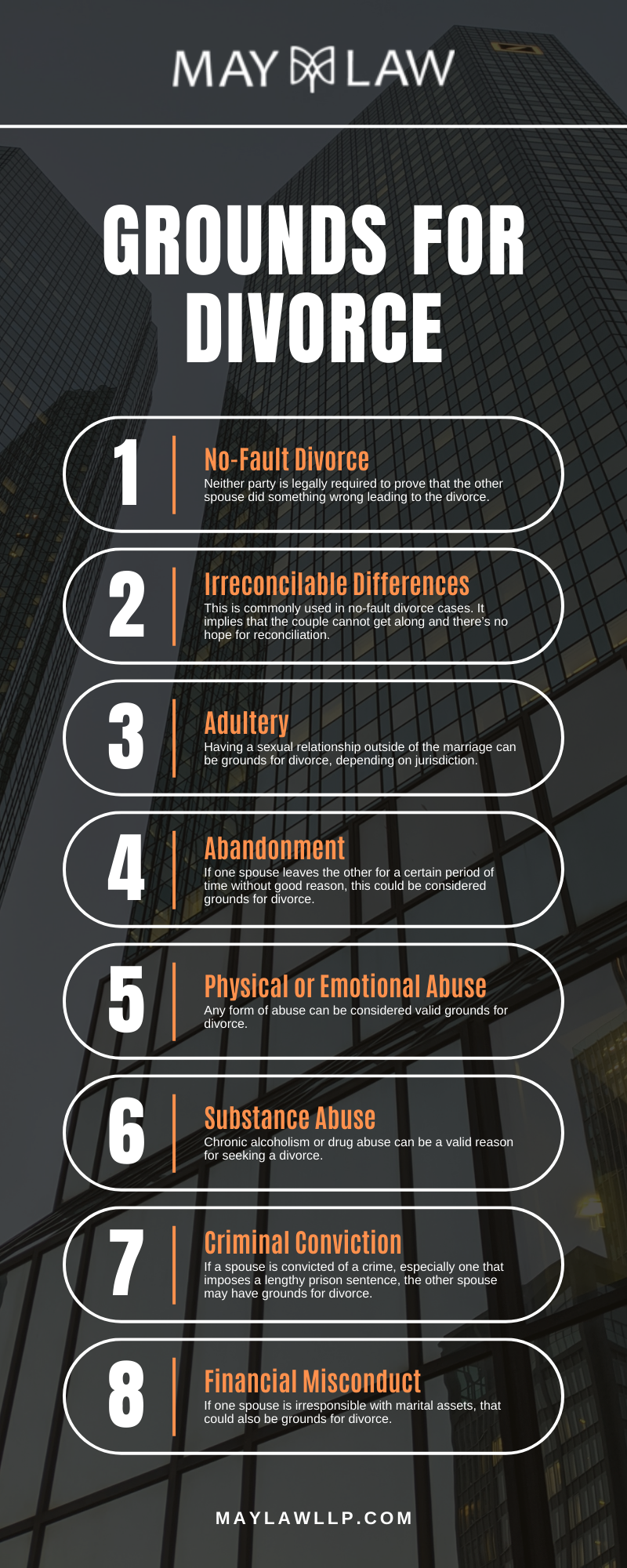
Virginia Divorce Infographic
Virginia Divorce Statistics
In Virginia, as in many communities, divorce statistics provide important insights into evolving marital trends. Recent data shows that the divorce rate in Virginia closely aligns with regional patterns observed across the state, where approximately 10–12% of the population is divorced. This figure is slightly lower than the national average in the United States.
It’s important to recognize that these statistics are shaped by various factors, including economic conditions, cultural shifts, and changing societal attitudes toward marriage and divorce. As such, the numbers may fluctuate over time, reflecting the ever-changing nature of personal relationships and community norms.
Divorce FAQs
What Are the Legal Grounds for Divorce in Virginia?
In Virginia, the law recognizes both fault-based and no-fault grounds for divorce. Fault-based grounds include adultery, cruelty, willful desertion or abandonment, and felony conviction resulting in imprisonment for more than one year. For a no-fault divorce, couples must live separately for one year—or six months if there are no minor children and a written separation agreement is in place.
Understanding the difference between separation and divorce is important, as the way you approach these requirements can directly affect outcomes related to alimony, asset division, and the overall timeline of your case.
How Is Property Divided in a Divorce in Virginia?
Virginia follows the principle of equitable distribution when dividing property in a divorce. This means the court aims to divide marital property in a manner it deems fair—but not necessarily equal. Marital property includes all assets and debts acquired by either spouse during the course of the marriage.
When determining how to divide these assets, the court considers several factors, including the contributions of each spouse (financial and non-financial), the length of the marriage, and the circumstances that led to its dissolution.
How Is Child Custody Determined in a Divorce Case in Virginia?
In Virginia, child custody decisions are made based on the best interests of the child. The court evaluates several factors, including the age and physical and mental condition of the child, as well as the age and physical and mental condition of each parent.
Other key considerations include:
The existing relationship between each parent and the child
The child’s individual needs
The role each parent has played—and is expected to play—in the child’s upbringing and care
Each parent’s willingness and ability to support the child’s ongoing relationship with the other parent
The court aims to create a custody arrangement that prioritizes the child’s well-being, stability, and long-term development.
Can Spousal Support Be Modified After the Divorce is Finalized in Virginia?
Yes, spousal support—also known as alimony—can be modified after a divorce is finalized in Virginia. Either party may petition the court to revise the amount or duration of support if there is a significant change in circumstances, such as a substantial shift in income or financial status.
However, it’s important to note that if the original spousal support agreement is clearly defined as non-modifiable in the divorce decree, it cannot be changed, regardless of future developments.
Is Mediation a Mandatory Part of the Divorce Process in Virginia?
Mediation is not mandatory in all divorce cases in Virginia, but it is strongly encouraged in many situations. Courts may order mediation in cases involving child custody and visitation disputes to promote a mutually agreeable outcome.
Mediation offers a cost-effective and less adversarial alternative to going to court. It allows both parties to work through their differences and negotiate terms with the help of a neutral mediator. However, the success of mediation depends on the willingness and ability of both parties to communicate and cooperate effectively.
Client Review
“Michael May was extremely responsive, professional and conscience of my time and his when working with me. I would recommend him to anyone who is need of a great lawyer.” Jason Dryer